
Washita County Parole Versus Probation
Parole and probation both permit supervision in the community, but they begin in different ways. The Oklahoma Pardon and Parole Board conducts the parole process for eligible state prisoners. Parole conditionally changes a person from confinement to community supervision while the state sentence continues. Probation comes from a court order. It may be tied to a suspended or deferred sentence and can take effect without the person first serving an ODOC prison term. ODOC Probation and Parole supervises both groups in the field.
Neither status establishes the exact time someone left Washita County Jail. A parole recommendation may still require further action and ODOC release processing. A probation order can coexist with another case, warrant, or detainer. The actual jail movement record remains the better proof of when Washita County stopped holding the person. The statewide record and court docket then explain what followed.
| Record type | Who starts it | What it means | Best verification |
|---|---|---|---|
| Parole | State parole process | Conditional release while a sentence continues | PPB result, current ODOC status, assigned office |
| Probation | Sentencing court | Court-ordered supervision, often with a suspended or deferred term | OSCN docket, certified court record, ODOC supervision record |
| Discharge | ODOC or court, depending on the obligation | The identified sentence or supervision term has ended | ODOC discharge record or court discharge order |
- Parole
- Conditional community release from an Oklahoma state-prison sentence before full discharge.
- Probation
- Community supervision ordered by a court instead of, or after suspension of, confinement.
- Discharge
- The formal end of the identified sentence or supervision duty.
- Revocation
- An official action that can cancel community status after a proven violation.
Verify Washita County Post-Release Supervision
A complete Washita County supervision check uses several official records. Begin with identity, not a status label alone. Similar names can lead to the wrong person, and an old docket can remain online after the status changes. The ODOC offender lookup is useful for people who entered Oklahoma corrections. It does not cover every person who bonded out of the county jail or received a county-only sentence.
- Search ODOC by the most exact name or identifier available, then compare the person details before opening the record.
- Read status and location first. Parole or probation points to community supervision, while discharged indicates an ended ODOC term.
- Search the OSCN docket system with Washita selected for a probation order, revocation, or discharge.
- Check the relevant PPB docket and result if parole was considered. Keep the result legend with the entry.
- Call the assigned ODOC office to confirm that the public record and reporting assignment are current.
- Request an official status or discharge record when the web result cannot answer the question.
The broader release-record path is covered on the Washita County released inmates search. It separates county release, state discharge, court disposition, and transfers to another custodian.
Washita County Cordell Supervision Office
ODOC lists a Cordell Probation and Parole office inside the county jail building. The row assigns the office both Washita and Kiowa counties. Yet the same current ODOC Probation and Parole offices page also places Washita in an “Inactive Counties” notation. That conflict matters. Call before traveling and ask ODOC to confirm which office now holds the reporting assignment. Proximity to the office is not proof that anyone is supervised there.
ODOC Cordell Probation and Parole
County Jail
400 North East McClary Street
Cordell, OK 73632
580-832-5059
Listed service area: Washita and Kiowa counties. Call first because the state page also carries a conflicting inactive-county notation.
The co-location does not turn the supervision office into a second detention facility. A person who reports there is not an inmate for that reason. Likewise, a person held in the jail is not automatically on parole or probation. The building houses two distinct functions, and each maintains a different type of record.
The official office listing gives no public walk-in hours. A phone check is therefore the prudent first step. Ask for the current office assignment, whether the public status is current, and which records route applies. Private case details may be restricted even when a basic public status is available.
The ODOC office listing captures the conflict directly. The official source shows the Cordell row and county notation.
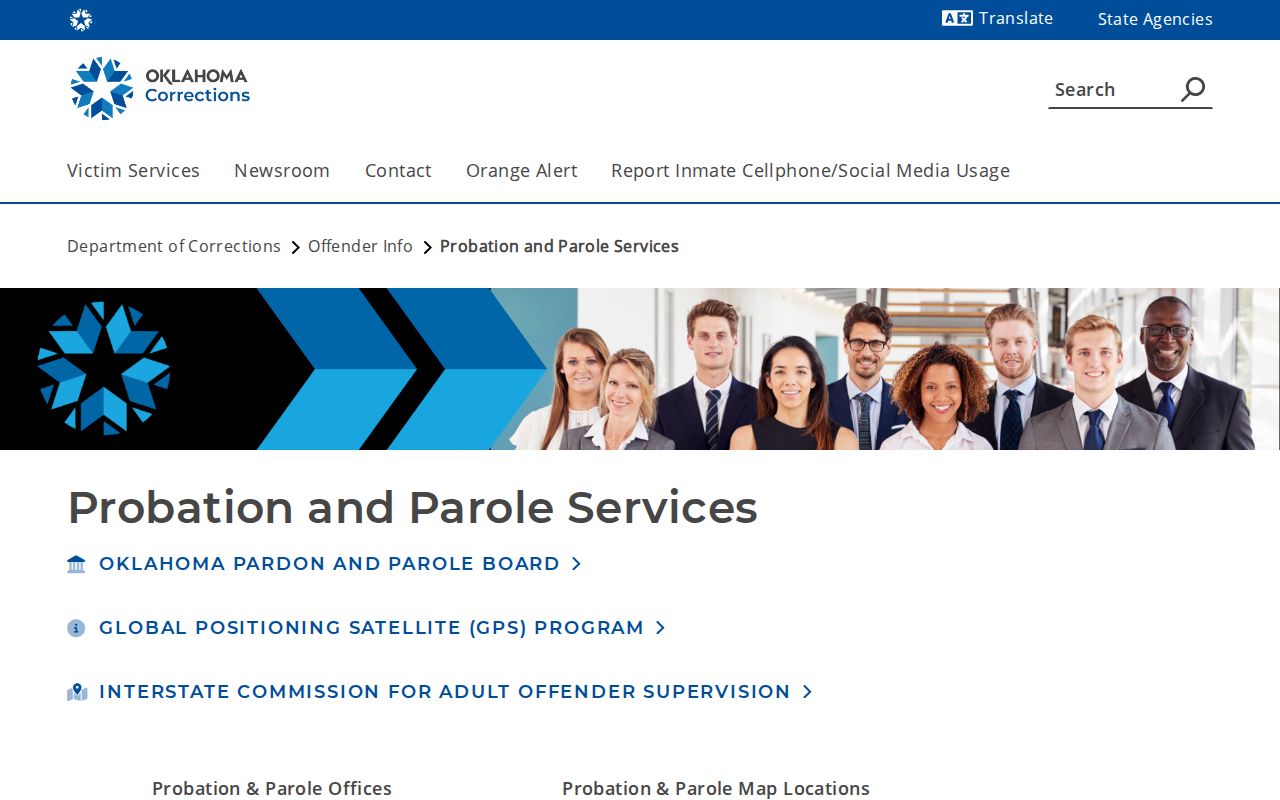
The image helps readers identify the correct state page, but a current phone confirmation remains necessary because the page contradicts itself.
Note: The office address and the jail address refer to the same site, but supervision and custody remain separate legal and operational statuses.
Washita County Parole Board Records
The PPB publishes annual meeting dates, agendas, minutes, monthly dockets, and results. Meetings are generally monthly, but the posted calendar controls. Cancellations and special meetings can change the pattern. Search the Dockets and Results hub by the correct year and month, then search the PDF by name or DOC number.
A docket shows that consideration was scheduled. Depending on the record, it may list the county, sentence, reception date, jail time, projected release date, and detainer data. The result document has its own codes. “Recommended to Governor,” “Admin Parole,” “Denied at Board Meeting,” “Stricken,” and “Passed to Another Docket” do not mean the same thing. “Street” is a docket classification or context, not stand-alone proof that the person physically left custody.
Most important, a PPB decision is not an actual release record. A recommendation can require gubernatorial action. ODOC must still process a lawful change in custody, and another sentence or detainer may keep the person held. Follow every Board result with current ODOC status and, if the actual move matters, the releasing facility record. A Washita county-jail-only sentence is outside the ordinary ODOC parole docket path.
The official parole hearing process shows how stages fit together.
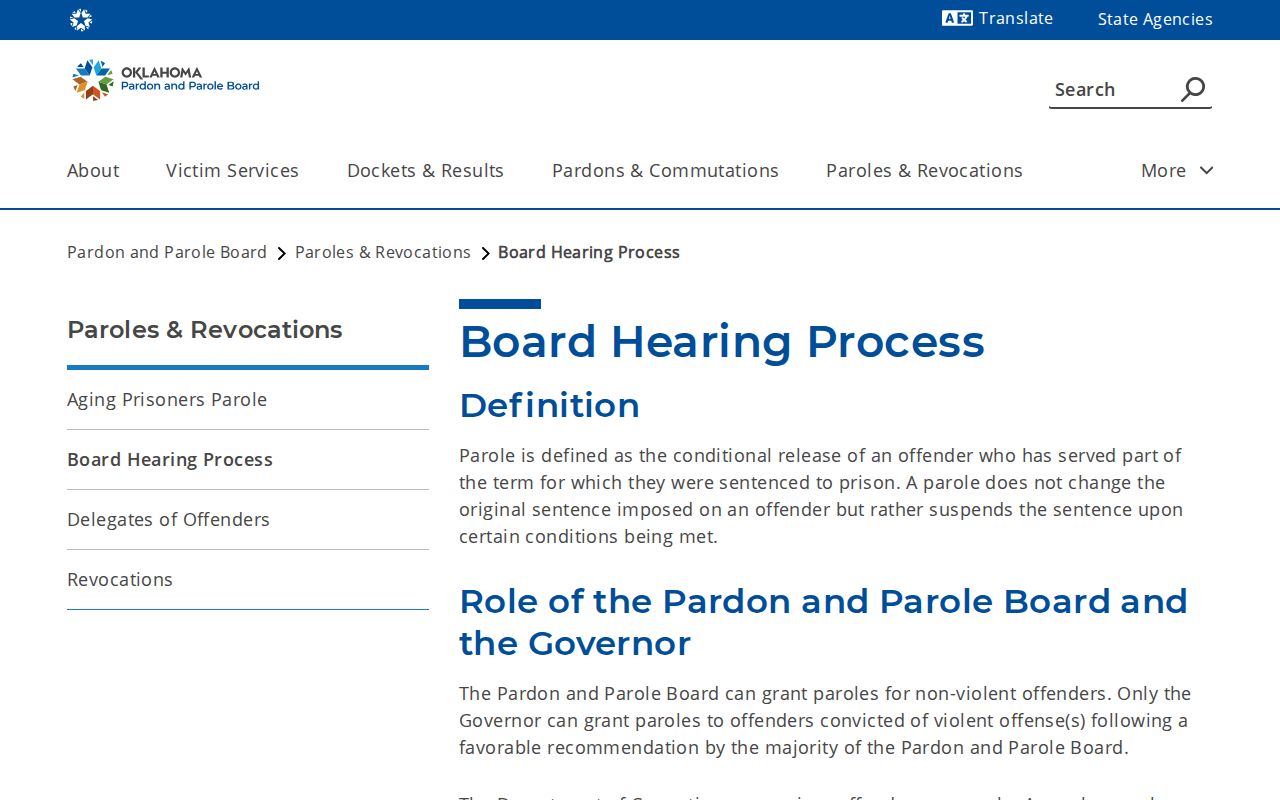
This view provides process context. It should be read with the monthly result and current ODOC custody or supervision status.
Washita County Supervision Warrant Check
An absconder is a supervised person alleged to have stopped reporting or otherwise avoided supervision. A warrant can follow. That status does not erase the earlier release. It usually shows that community supervision existed and a claimed violation arose later. Revocation may return the person to custody, but only the official process establishes that result.
The WCSO Most Wanted page is a local cross-check, not a final warrant database. The sheriff warns that routine updates may leave a listing stale and that no one should act solely on what appears there. Confirm any listing with WCSO or ODOC Fugitive Warrants. Never approach a person based on a web result.
- ODOC Fugitive Warrants local numbers: 405-425-2570 and 405-425-2571.
- Toll-free state warrant line: 866-363-1119.
- Email: warrants@doc.ok.gov.
- For a court-issued warrant, check the Washita docket and issuing court as well.
VINE can report certain custody changes, and PPB describes parole-event notices, but it is not the source that validates a warrant. A missed alert also does not settle custody. Use the issuing agency for confirmation.
Note: A stale or unmatched warrant listing can cause harm, so record the retrieval time and confirm the exact identity before drawing any conclusion.
Washita County Supervision Terms
Conditions are the rules attached to parole or probation. They can involve reporting, travel permission, treatment, payment, testing, contact limits, or compliance with other court terms. The exact set comes from the governing order and supervision record. Do not infer one person's conditions from another person's case or from a general description.
A claimed violation is not the same as a final revocation. The supervising officer, court, or parole authority follows the process that applies to that status. A warrant may authorize arrest while the merits are unresolved. Court dockets can show a probation violation filing, hearing, revocation, or later discharge. ODOC and PPB records handle state parole events. Each record must be read in date order.
Registry duties are separate. Oklahoma sex and violent offender registries apply only to qualifying people and offenses. A registry entry may remain while the person is supervised, discharged, or even confined. Its presence does not supply a general release date. Its absence does not prove that supervision ended.
Washita County Supervision Discharge Records
Parole ends when the relevant sentence or supervision term is discharged or otherwise lawfully terminated. Probation may end through completion, a court discharge, revocation, or another authorized order. “Discharge” must always be tied to the record that uses it. An ODOC sentence discharge and a court discharge from probation are related only when the underlying case makes them so.
For probation, read the Washita OSCN docket and obtain a certified order from the court clerk when formal proof is needed. For state supervision, check ODOC status and use ODOC Legal Services for the applicable authorization or discharge-record route. The state lists its Closed Records unit at 405-425-2691. Registry discharge questions use the specialized contact shown by ODOC rather than the county jail.
A jail release timestamp, parole date, probation start, revocation, and final discharge can all differ. Keep each date under its own label. That simple practice prevents a board recommendation or court entry from being mistaken for a completed physical release.