
Washita County Projected Release Meaning
A projected release date is a calculation based on facts known at a given time. ODOC calls its calculated date tentative and subject to change. The official worksheet and parole dockets use the exact label “Projected Release Date.” That phrase should not be changed into guaranteed date or actual release. The projection moves as days are served, credits are earned or lost, court records are corrected, and other restrictions are applied.
An actual release date records what happened. It marks the end of custody for a named agency and may include a time, release authority, and destination. Even then, release from Washita County Jail can lead to another custodian rather than the community. A detainer, meaning another authority's request to hold or receive the person, may send that person elsewhere as soon as one local matter ends.
A parole recommendation also is not physical release. The Oklahoma Pardon and Parole Board decision may require later action, and ODOC must process the custody change. The current ODOC status and the releasing agency's record provide the next evidence.
Washita County Release Date Paths
The first task is to classify the custody. Applying ODOC credits to every person in the Washita County Jail produces a false answer. Pretrial custody, a short county sentence, and an ODOC sentence each use a different source and calculation.
| Custody path | How the release date works | Best source |
|---|---|---|
| Washita pretrial detainee | Often no fixed date; bond, court action, charging decisions, competency, and holds can control. | Washita County Jail, OSCN, and the court clerk. |
| Washita county sentence | Uses the judgment, sentence start, jail-credit award, and WCSO calculation. | Judgment and sentence plus WCSO jail records. |
| ODOC state sentence | Uses reception, term length, jail credit, monthly service, earned credits, losses, and restrictions. | ODOC offender information and correctional records staff. |
| Parole consideration | A hearing result may affect custody, but it is not an exit time or full discharge. | PPB docket and result followed by current ODOC status. |
A county defendant who posts accepted bond may still remain held on another warrant or detainer. A sentenced Washita person delivered to ODOC is no longer calculated as a county-only jail term. Follow the authority that actually holds the person instead of using the county of conviction as the database choice.
Note: The Washita public roster is a current-custody list and does not display a county projected release date.
Find Washita County Projected Dates
Use the last confirmed custodian and preserve the retrieval time. The ODOC offender information page links the state lookup and warns that the system's data source may have unexpected issues. A missing or odd result needs confirmation, not a guess. For a county detainee, the state lookup may have no record at all because a person who only bonded out or served a county term never entered ODOC custody.
- Confirm whether the person is pretrial, serving a Washita County sentence, or in ODOC custody.
- For county custody, read the OSCN case for bond, judgment, jail credit, and later court orders.
- Ask WCSO for the current calculation when a county sentence has a possible completion date.
- For state custody, open the ODOC offender lookup and match the name, DOC number, status, and facility.
- Record any displayed projection exactly as labeled and note the date the record was retrieved.
- Check sentence, case, jail-credit, and detainer information for facts that can change the projection.
- Ask the facility records officer or case manager about an exact or disputed ODOC calculation.
The ODOC guidance shown in the manifest image provides the official search route and its warning about release-date information.
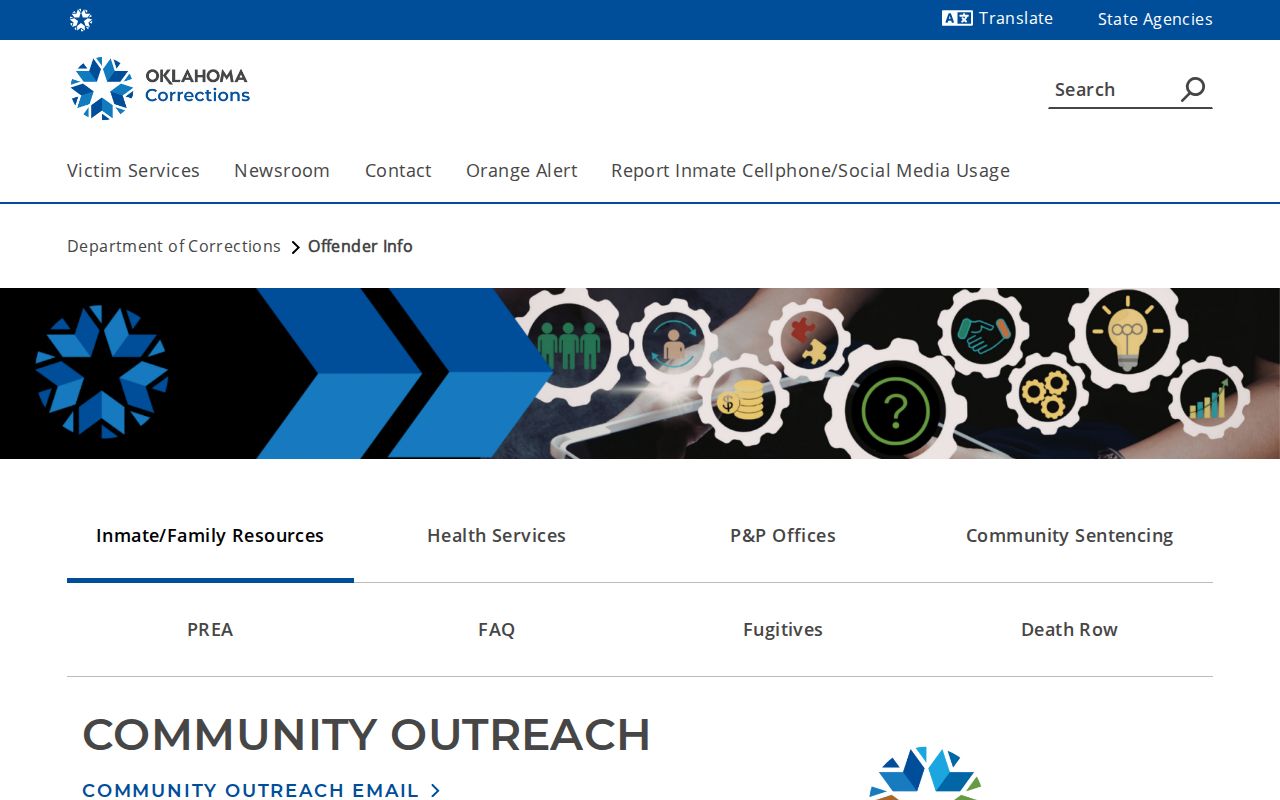
The screenshot supports the state-prison path. It does not replace WCSO and court records for a county-only sentence.
Washita County Sentence Date Calculation
A pretrial Washita County detainee usually lacks a computable sentence end because no final incarceration term has been imposed. Bond status can change. A charge may be dismissed or amended. Competency proceedings, another case, or a hold can keep custody in place. OSCN may show the legal event, but the jail transaction is needed to confirm the physical movement.
For a county sentence, gather the judgment and sentence, the ordered jail credit, the date custody began for that term, and WCSO's calculation. Jail credit is time credited toward a sentence for qualifying custody already served. The sentencing order generally controls presentence credit. Do not add ODOC earned-credit classes unless ODOC law and records actually govern that person's custody.
When the county record and court order appear inconsistent, ask for the calculation inputs rather than doing arithmetic from a docket summary. Multiple cases may run at the same time or one after another. In ordinary terms, concurrent sentences overlap, while consecutive sentences are served in sequence. Another county, tribal, state, or federal hold can also prevent community release when the local term reaches its end.
The Washita County release-record search explains how the local jail transaction and court history answer different parts of the final release question.
Washita County ODOC Earned Credits
For a Washita County person serving an ODOC sentence, the state calculation starts with the imposed incarceration term and reception date, converts the term to days remaining, and updates the balance. Each month adds time served and applies credits earned or lost. When the lawful days remaining reach zero, the sentence discharges. A discharge ends the state sentence or status identified in the record; it should not be confused with a projected date shown earlier.
Under 57 O.S. §138 as explained in ODOC's sentence-credit guide, ordinary class levels are described as earning zero days at Level 1, 22 at Level 2, 33 at Level 3, and 44 at Level 4 per month. Enhanced Level 3 and 4 are described as 45 and 60 days, subject to statutory eligibility limits. Achievement credit may also apply. Section 138.1 addresses meritorious earned credit of up to 100 days for a qualifying act.
| ODOC credit class | Ordinary monthly credit |
|---|---|
| Level 1 | 0 days |
| Level 2 | 22 days |
| Level 3 | 33 days |
| Level 4 | 44 days |
| Enhanced Level 3 | 45 days, when eligible |
| Enhanced Level 4 | 60 days, when eligible |
Credits are not guaranteed. Discipline, misconduct, or nonperformance may remove them or lower a class. Section 138 permits consideration of restoration, but ODOC states that restoration is discretionary, meaning it is not an entitlement. Court changes, verified jail credit, parole, and later class movement can alter the balance as well.
ODOC also publishes rough planning factors for each credit class: 1.00, .58, .48, .41, .40, and .34 in the same class order. Those factors estimate how service and possible credit might interact. They are not a safe personal release-date formula. The actual computation may include a credit restriction, later class move, credit loss, court correction, or a jail-credit decision that the simple factor does not show.
Washita County 85 Percent Limits
Oklahoma's 85-percent rule is not universal. 21 O.S. §13.1 applies to the serious offenses listed in the current statute, including covered attempts, conspiracies, or solicitations. For a sentence governed by that section, at least 85 percent must be served before parole consideration, and credits cannot reduce the term below that statutory floor. Ordinary credits can still affect institutional accounting or the part of a sentence above the floor, but they cannot create release below 85 percent. Other mandatory minimums and credit restrictions may also control. A short conviction label is not enough because amended counts, the offense date, multiple cases, and concurrent or consecutive terms can change the result.
The official Section 13.1 page shown here is the source for the current legal text.
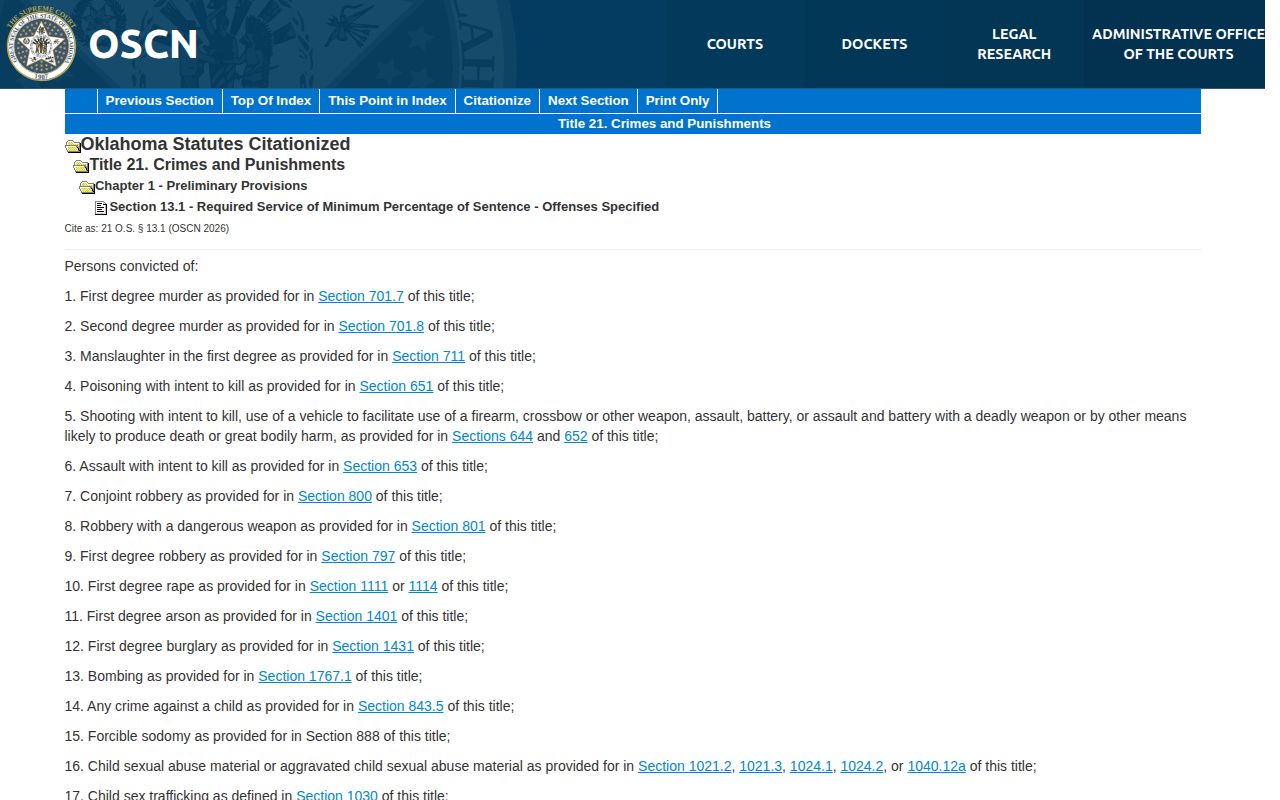
Use the statute with the judgment, sentence, and ODOC calculation. Do not apply the percentage to every Oklahoma sentence.
Note: A parole eligibility date and a projected sentence release date can be different dates with different legal meanings.
Why Washita Projected Dates Change
A projection is rebuilt from changing inputs. Some changes reduce time remaining. Others set a floor or prevent physical release even when one term ends. The event must be tied to the correct case and custodian.
| Event | Possible effect on release |
|---|---|
| Monthly days served | Reduces the balance still to be served. |
| Credit-level movement | Changes the rate of future earned credit. |
| Achievement or meritorious credit | May reduce time remaining when lawfully authorized. |
| Misconduct or discipline | Can remove credits or lower the earning class. |
| Credit restoration | May restore some loss after approval, but is discretionary. |
| Court correction | Changes the sentence or credit legally imposed. |
| Verified jail credit | Adds or corrects presentence or post-sentence credit. |
| Detainer or another sentence | May prevent community release after one term ends. |
| Parole decision | May shift custody to supervision after all required action and processing. |
| Mandatory restriction | Sets a floor ordinary credits cannot cross. |
ODOC provides rough projection factors for its credit levels, but those are planning estimates. They cannot safely calculate one person's public date because later class changes, losses, court modifications, jail credit, parole, and restricted sentences all matter. Use the official calculation and correctional records staff.
Confirm Washita County Release Dates
ODOC treats an inmate's exact release date as confidential without a legitimate need and directs authorized release concerns through proper channels. The incarcerated person receives days remaining information and can seek help from a case manager or correctional records officer. Public offender information, downloadable data, parole dockets, and ODOC records each reveal different parts. A date found in one source does not make every exact date publicly available.
For an ODOC prisoner, save the matched status, facility, sentence information, and any displayed projection. Check PPB dockets and results if parole is involved, then return to current ODOC status. A recommendation is not final physical release. For a county sentence, use the Washita judgment, jail-credit award, and WCSO calculation. For an actual event, request the release or transfer transaction from the agency that held the person.
An official PPB docket can show the projected release label beside the county, sentence, reception date, jail time, cases, and detainer information. Its companion result uses a legend for the hearing outcome. Read both records together. A passed or stricken matter is not a release, and a recommendation still requires the action and ODOC processing that apply to the case.
An alert can help monitor what happens next. The Washita County VINELink inmate search explains how to match the reporting agency and register for release or transfer notices. VINE is an event monitor, not proof that a tentative date became an actual release.